Unrequited love and romantic idealization
Great ExpectationsUnrequited love and romantic idealization in Great Expectations are most sharply expressed through Pip’s attachment to Estella, a desire that survives his knowledge that it is neither returned as tenderness nor sustained by reason. Miss Havisham’s imperative to love Estella gives that longing a script, but Pip’s mature account complicates the romance: he does not claim that Estella is perfect; he loves her because he finds her irresistible, even while recognizing what the attachment costs him. The result is a love that elevates Estella into the center of Pip’s hopes while drawing him away from the people and loyalties he might otherwise value.
The Romantic Story Pip Tells Himself
One morning, before visiting Miss Havisham, Pip wanders through the countryside on her side of town, imagining what she intends for him. He supposes that she has effectively adopted him as well as Estella and means to bring them together. In his private romance, he will restore the desolate house: open its dark rooms to sunshine, set its stopped clocks going, warm its cold hearths, and clear away cobwebs and vermin. He casts himself as a young knight who will revive the ruined place and marry its princess. Estella is both the inspiration and the heart of this imagined future.
The fantasy is vivid, but Pip’s narration places an important limit on it. He says that he did not assign Estella qualities she did not possess, even in this romantic frame of mind. Looking back, he rejects the conventional explanation that lovers must believe the beloved perfect. His account is more troubling and more candid: he loved Estella because he found her irresistible, and knew that he loved her against reason, promise, peace, hope, happiness, and every discouragement. Awareness did not weaken the attachment. It made no more difference to his desire than if he had believed her to be human perfection.
That distinction separates idealization from simple praise. Pip does imagine a destiny in which Estella belongs at the center of his life, and he reads Miss Havisham’s household as a stage prepared for their union. Yet he does not explain his love by pretending Estella is flawless. The fantasy concerns what he hopes she and the ruined house will mean for him; the passion itself persists despite what he knows. In retrospect, that gap between knowledge and desire becomes the defining contradiction of his attachment.
Miss Havisham’s Command
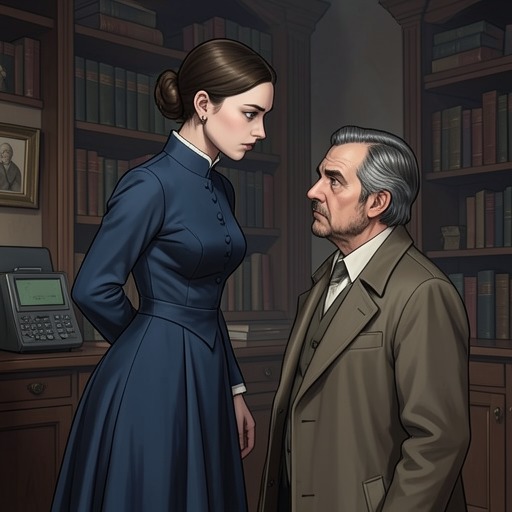
Miss Havisham turns Pip’s longing into an explicit obligation. Drawing his head close as she sits in her chair, she asks whether Estella is beautiful, graceful, well-grown, and admired. Before Pip can answer her difficult question about how Estella treats him, Miss Havisham repeats her order: he is to love Estella whether she favors him, wounds him, or tears his heart apart. She imagines the injury deepening as Pip grows older and stronger, but presents continued love as the required response.
She then explains the purpose she claims for Estella’s upbringing: she adopted her to be loved, bred and educated her to be loved, and developed her into what she is so that she might be loved. In this exchange, Miss Havisham does not merely encourage a match. She names Estella’s formation as part of a design centered on being loved, and presses Pip to occupy the role that design requires. Her instruction makes emotional suffering sound not like a reason to withdraw, but like a test of fidelity.
Miss Havisham’s definition of real love intensifies that demand. She describes it as blind devotion, unquestioning self-humiliation, utter submission, and trust against oneself and the whole world, ending in the surrender of one’s heart and soul to the person who strikes. She presents her own experience as its model. The intensity with which she speaks, and the physical force visible in the thin arm around Pip’s neck, make the command feel less like detached advice than an inheritance of her own wounded emotional logic.
Pip later hears the repeated injunction in his guardian’s room at the Blue Boar. Far into the night he adapts it for himself, repeating that he loves Estella hundreds of times to his pillow. He feels a burst of gratitude that she should be destined for him, once the blacksmith’s boy, then immediately wonders when she will become interested in him and when the silent heart within her will awaken. His hope depends on a future change in Estella, but the evidence he gives is her present lack of response. Miss Havisham’s command becomes Pip’s private refrain, turning uncertainty into a reason to repeat his devotion.
Desire, Distance, and Social Shame
The attachment affects Pip’s conduct beyond his fantasies and repetitions. He admits that he never thought there was anything low or small in keeping away from Joe because he knew Estella would be contemptuous of him. Only a day earlier, Joe had brought Pip to tears; those tears dried quickly. Pip’s retrospective self-accusation shows how thoroughly Estella’s imagined judgment has displaced gratitude and affection for Joe. The harm is not only that Pip suffers from unreturned love: he also participates in the class shame and estrangement that make him conceal the person who has cared for him.
When Estella travels with Pip, he sees that she cares to attract him and makes herself winning, and he believes she could have won him even if it had required effort. The attention does not make him happier. He interprets her manner as evidence that she holds his heart because she chooses to do so, not because his pain would awaken tenderness in her. Attraction and reciprocity remain separate: Estella may deliberately draw Pip toward her without returning the vulnerable affection he hopes to find. His reading leaves him captive to her influence even as it denies him the reassurance of mutual love.
The pattern also shapes the way Pip imagines the future. He asks when he might awaken Estella’s heart, treating its silence as a condition that could eventually change, while recognizing that she is not yet rapturously grateful for the destiny he believes awaits them. In the scene with her, he is unhappy not because the attraction has vanished, but because attraction cannot assure tenderness. His hope repeatedly projects a response into the future; his experience repeatedly gives him grounds for doubt.
Narrative Significance
Pip’s first-person retrospective account holds the younger man’s romantic expectations beside the older narrator’s knowledge of their contradictions. The ruined house initially lends his hopes the shape of romance: a dark, desolate place awaiting restoration, with Estella imagined as its princess. But the narrator explicitly warns that the story of the lover who simply mistakes the beloved for perfection does not explain his experience. He loved Estella while knowing the love was against reason and hope, and describes that knowledge as powerless to restrain him.
Miss Havisham’s repeated command supplies a language for that persistence, but also exposes its cost. Her model of love joins devotion to submission and humiliation; Pip echoes her words privately, then measures his prospects by whether Estella’s silent heart might awaken. The cycle connects romantic longing to self-abasement and social alienation, especially in Pip’s shame about Joe. The evidence does not make suffering proof of a destined union. Instead, it shows how a desired future can govern Pip even when he recognizes the disparity between his hopes and Estella’s tenderness.
The concept therefore rests on a tension rather than a simple mistake: Pip knows Estella as she is, yet his desire makes her central to a destiny he has imagined for them. Miss Havisham’s design encourages that attachment, and Pip’s own repeated professions keep it alive. Its force lies precisely in the distance between clear recognition and emotional surrender.